The first nine landholding servitors and a separate archival sheet about Pavel Anfilogov.
The Oryol Core: Nine Landholders
The cadastral survey book (pistsovaya kniga) of Oryol district for 1594/95 records no fewer than nine landholders bearing variants of the surname Anfilogov. This is no longer a lone line in a register but a whole neighbourhood: homesteads, fields and hay meadows belonging to one family name.
Service in Exchange for Land
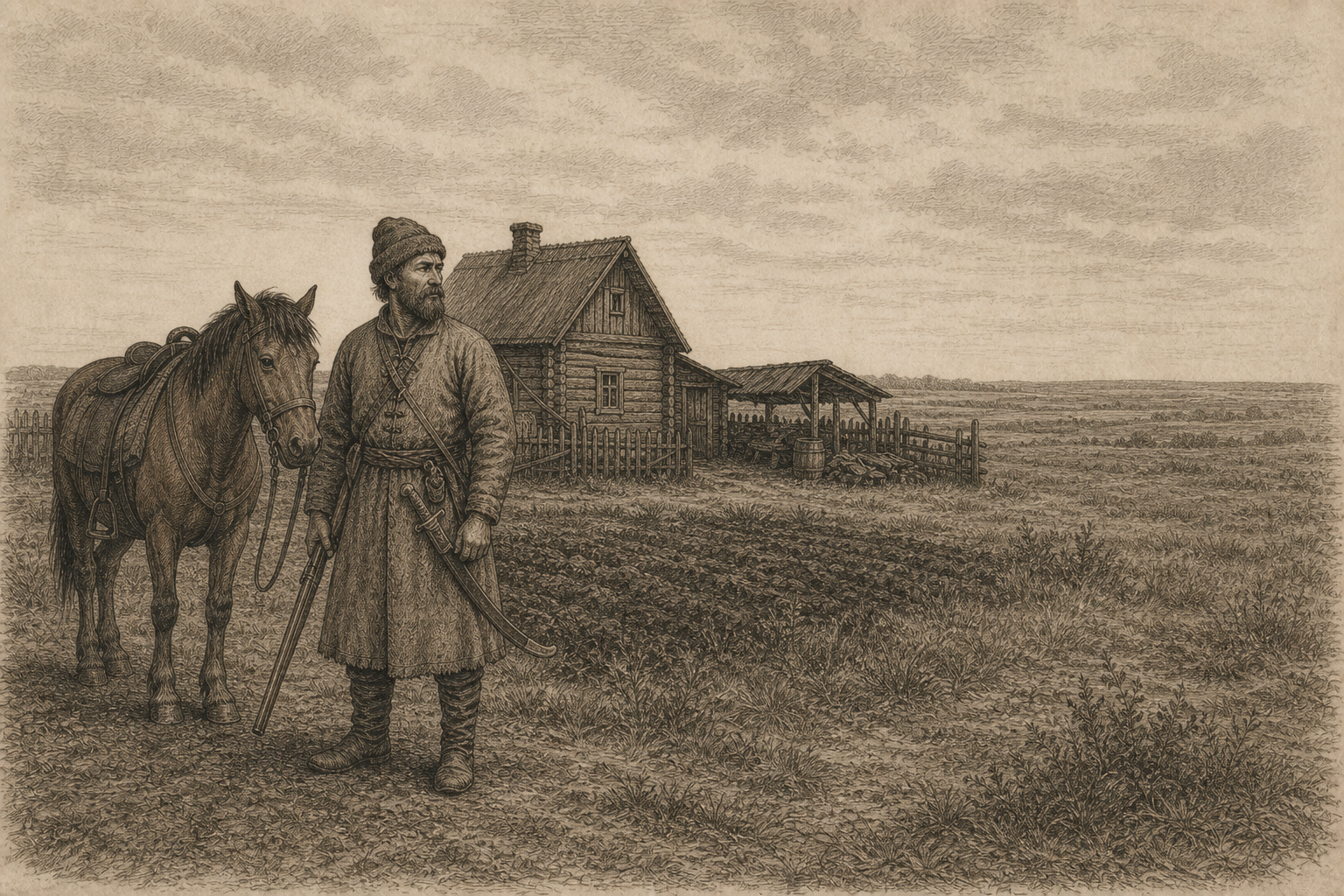
All of them were deti boyarskie ("boyars' children"). The name is misleading: these men had nothing to do with the boyars. That was the term for provincial servicemen, the backbone of the army of the time. The sovereign granted such a man a pomestye — land enough to live on — and in return he had to report for service at the first summons, with a horse, weapons and a supply of food. A pomestye was not private property: if a man stopped serving, the land could be given to someone else.
They served in different ways. The survey book divides the Oryol landholders into regimental, stanitsa, samopal and siege men: some went with the regiments; others rode in the stanitsy, mounted patrols that ranged the steppe watching for Tatars; a third group fought with a hand-held firearm, the samopal; a fourth defended the fortress itself. From 1571 the order of the steppe patrols was set by the boyar verdict on stanitsa and watch service — the first such regulation, drawn up by the voivode Mikhail Vorotynsky.
The main threat was the Crimean Tatars. The Crimean Khanate lived largely by raiding: almost every summer its mounted bands rode out of the steppe, burned villages and drove off captives, who were then sold into slavery at the slave markets of Crimea. So a serviceman's year was split in two. In spring, when the steppe dried out and a raid could be expected, he went off with the regiments to the southern frontier. In autumn he came back to his homestead, his ploughland and his hay meadow. Oryol stood not far from the edge of the settled lands — almost in the path of these raiders.
In the book the forms Onfilogov, Anfilogov and Anpilogov appear side by side. Five homesteads stood in the village of Bazdyrevo, and three of their owners — Vasily, Timofey and Karp — are explicitly named as brothers, sons of Mikula.
Vasily, Timofey and Karp are recorded as Mikula’s children.
The same patronymic and the same village suggest a common father.
The solid line follows the cadastral book’s explicit formula; the dashed line shows a probable link that the document does not call kinship.
More Land than Ploughland
The estates were tiny. The holders had between two and five hectares of ploughland per field, surrounded by several times as much unploughed "wild" land. For none of the nine does the book record an inhabited peasant household — only empty ones. That means they mostly ploughed the land themselves, between campaigns.
Ivan Nechaev on the Radomlya had no ploughland at all yet. His land was a zaimishche — a newly taken-up plot granted a seven-year exemption from taxes.
| Holder | Place | Ploughland, chetverti | Wild field, chetverti | Hay, stacks (kopny) |
|---|---|---|---|---|
| Belyai Vasilyevich Onfilogov | Bazdyrevo | 9 | 51 | 115 |
| Osip Vasilyevich Anfilogov | Bazdyrevo | 5 | 19 | 70 |
| Vasily, Timofei and Karp Mikulin | Bazdyrevo · held jointly | 6 | 51 | 115 |
| Ivan Pershin Anfilogov | Belaya | 4 | 29 | 50 |
| Sofon Timofeyev Anfilogov | Sofonovo | 4 | 36 | 85 |
| Yermak Pakhomov Anpilogov | Maltsovskaya | 7 | 19 | 40 |
| Ivan Nechayev Anpilogov | clearing on the Radomlya | 0 | 15 | 80 |
Ploughland and wild field are given «в одном поле» [“in one field”] of the three-field rotation.
The map links the cadastral description to modern place names. Sofonovo is shown as an area rather than a precise point: the settlement has disappeared, and the available historical map allows for error. Sources and limits of accuracy.
In 1596 a young man, Pavel Terentyev syn Anfilogov (Pavel, son of Terenty, Anfilogov), was enrolled in service. Such newcomers were called noviki (novices), and each was assigned an oklad — the amount of land he was entitled to for his service. Pavel was assigned 250 chetverti (a chetvert was about half a hectare). This was an entitlement, not an actual allotment: his neighbours, even counting their unploughed fields, held several times less.
Editorial reading of the line: «Павел Терентьев сын Анфилогов» [“Pavel, son of Terenty, Anfilogov”].
Russian State Archive of Ancient Acts (РГАДА). F. 181. Op. 2. D. 120. L. 58 verso. Digital image 0060.
Source fragment; the line highlighting was added by the editors.Where the Oryol Families Came From
Oryol was founded in 1566 by order of Ivan the Terrible: a fortress at the confluence of the Orlik and the Oka shielded the southern districts from Crimean Tatar raids. The land around it was handed out to servicemen, and the town gained defenders who lived close by.
There were not enough people. In 1576 Oryol was supposed to have 500 mounted Cossacks — servicemen on horseback of humbler standing than the deti boyarskie, who were sent out on steppe patrols — but only 80 were actually present. Servicemen were gathered from everywhere, and among those whom service brought here were the ancestors of Anfilogovs. Exactly where they came from remains a mystery for now.
For researchersSources, caveats and open questions of this chapter
The survey book of 1594/95. Eight holders are recorded in Korchakov stan and one — Ermak Pakhomovich on the Nugr — in Nougorsk stan; stany were subdivisions within a district. The estates are described by zherebya — shares of a common land grant. Belyay and Osip Vasilyevich of Bazdyrevo may have been brothers, but the record contains no such formula. Empty peasant households are noted for Belyay (one) and for Ermak (two). S-OREL-1594 S-BOYAR-CHILDREN
Measures. A chetvert is roughly half a desyatina, 0.58 hectare. Ploughland was counted «в одном поле, а в дву потому ж» ("in one field, and in the other two likewise"): the figure refers to one of three fields. So nine chetverti in an entry means about 5.2 hectares in one field, not the area of the whole holding. Ivan Nechaev's zaimishche was granted an exemption from 20 January 1595 to 20 January 1602. S-OREL-GEOGRAPHY
The novik of 1596. An oklad of 250 chetverti is the prescribed entitlement; the record does not prove that all of that land was actually granted. S-OREL-1596
Where the families came from. The 1576 roster records a shortfall: of the 500 mounted Cossacks due, Oryol had 80, so the 420 are an unfilled quota, not a count of settlers. There is no list naming Anfilogov settlers. The published survey books of Tula, Dedilov, Kashira, Venev and Epifan have been checked in full and the surname does not appear in them; the books of Karachev, Bolkhov, Mtsensk, Novosil, Chern and Bryansk are not in the edition. S-PKMG-SWEEP · Research note
Service categories. The list of "regimental, stanitsa, samopal and siege" deti boyarskie follows the stan headings in the survey book of 1594/95. A possible predecessor of one of the Oryol landholders is the Putivl strelets-samopalnik (musketeer) Belyay Vasilyev, who received land in the Putivl steppe in 1593/94: his first name and patronymic match Belyay Vasilyevich Onfilogov, but the surname and the move are not proven.