The bishop of Iconium, the Novgorod Menaion of 1097 and Russian bearers of the church name.
Amphilochius: From the Church Calendar into Russian Speech
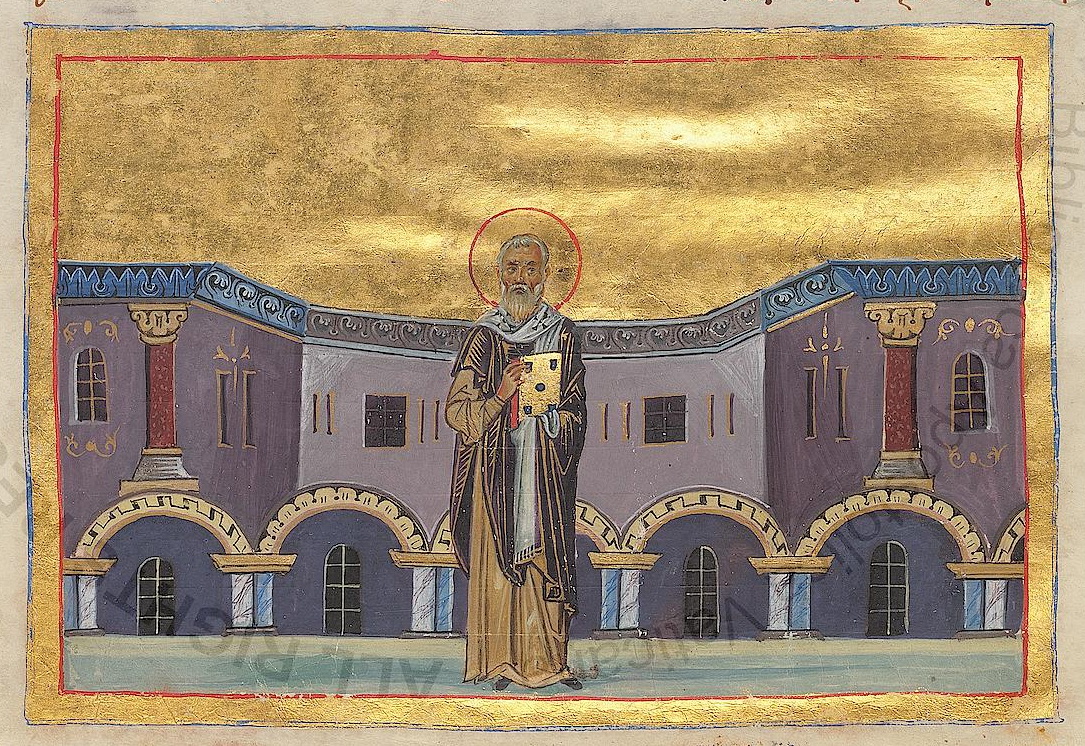
The saint from whom the name comes was a lawyer's son. Amphilochius was born around 340 in Cappadocia, a region in the heart of Asia Minor, in what is now Turkey. His father was also named Amphilochius: he was a rhetor, a teacher of eloquence, and pleaded cases in court.
The father's sister was the mother of Gregory the Theologian (Gregory of Nazianzus), one of the most revered preachers of the Church, so the famous Gregory was the younger Amphilochius's first cousin. He corresponded with both of them, and it is through his letters that the family is still known today.
From the Courtroom to Asceticism
The son followed in his father's footsteps: he studied law and worked in Constantinople, the empire's new capital. But a career in the capital could not hold him. Amphilochius left the city and chose asceticism, a life of fasting, prayer and poverty.
Around 373–374 the former lawyer was made bishop of Iconium, present-day Konya. He formed a close friendship with Basil the Great, one of the leading theologians of the age. It was through Basil that Amphilochius found himself at the very centre of the dispute that was then splitting the Church.
The Dispute over the Holy Spirit
Fourth-century Christians argued about the most fundamental question of all: what God is. At the beginning of the century the Alexandrian priest Arius taught that the Son was created by the Father and was therefore lower than Him. The First Ecumenical Council, at Nicaea in 325, rejected this: the Son is equal to the Father. But soon the same question arose about the Holy Spirit. Some held the Spirit to be merely a ministering power, a creature of God. Others, Basil above all, taught that the Father, the Son and the Spirit are equal and are one God.
People argued even over the words of prayer. Basil glorified God sometimes "through the Son in the Holy Spirit", sometimes "with the Son and with the Holy Spirit", and his opponents accused him of innovation. Amphilochius asked his friend to explain what this meant. The answer was the book On the Holy Spirit, which Basil addressed directly to him. And in 376 Amphilochius hosted a council of bishops at Iconium, and the council took Basil's side.
The matter was settled by the council in Constantinople in 381. Basil did not live to see it, but Amphilochius was among the bishops, and their side prevailed. Into the Creed, the short statement of the essentials of the Christian faith, was added that the Holy Spirit «со Отцем и Сыном спокланяем и сславим» ("together with the Father and the Son is worshipped and glorified"), that is, honoured equally with them. These words are still heard at every liturgy today.
A Lesson for the Emperor
The fifth-century church historian Theodoret preserved this story about Amphilochius. The bishop asked Emperor Theodosius to ban the assemblies of Arius's followers, but the emperor considered the measure too harsh. So Amphilochius came to the palace, bowed to the emperor, and seemed not to notice Arcadius standing beside him, the son whom his father had recently made co-ruler. Theodosius reminded him of his son. "I have paid him honour," the bishop replied. The emperor grew angry: his heir had not been given his due.
That was exactly what Amphilochius wanted. If the sovereign cannot bear to see his son slighted, he said, then God too rejects those who belittle His Son. According to Theodoret, the emperor soon banned the assemblies of the Arians.
Another historian of the same century tells this scene about a nameless old priest, so we may be dealing with a legend. But the Church's memory attached it specifically to Amphilochius.
Amphilochius died after 394. The Church commemorates him on 23 November.
Novgorod, 1097
The November Service Menaion, a book of services for each day of the month, preserves the service to Amphilochius in a manuscript completed in Novgorod in 1097. Rus' had been baptised only a little over a hundred years earlier, yet the service to a distant Greek bishop was already being read in Slavonic. It is one of the oldest precisely dated Russian manuscripts. For our story, what matters most is how the name is written in it: Amfilogiy, with g instead of kh, the same g that is heard in the surnames Anpilogov and Ampilogov.
The service calls Amphilochius (Amfilogiy) «божественным громом и трубой духовной» [“divine thunder and spiritual trumpet”], a teacher of the faithful and an opponent of heresies, and then asks for his unceasing prayer for all.
«Служебные минеи за сентябрь, октябрь и ноябрь» [Service Menaia for September, October and November] / ed. V. Jagić. St Petersburg: Imperial Academy of Sciences Press, 1886. P. 436; text after the Novgorod Service Menaion of 1097.
Source fragment; the line highlighting was added by the editors.Scribes wrote «Амфилогий» (Amfilogiy), while living speech went further, to Ampilog and Anpilog.
The Name in Rus'
As early as 1105 the chronicle reports that a man named Amphilochius was made bishop of Volodymyr-Volynskyi, in the west of Rus'. In the fifteenth century the name was borne by Amfilokhiy of Glushitsa, abbot of a monastery in the Vologda region.
But more often the name came not from chronicles but from the church calendar of saints (svyattsy). A child was usually named after the saint whose feast fell on the day of birth or baptism.
A boy born on 23 November, the feast day of Amphilochius, was often given that very name: Amfilokhiy, or, as it was more often written in parish registers, Anfilokhiy.
The next step is already visible in secular documents: first Anfilof Selivanov, then Tonkoy Onfilogov. They are the subject of the next chapter.
For researchersSources, caveats and open questions of this chapter
Amphilochius of Iconium. Father and son are mentioned in the letters of Gregory the Theologian; Amphilochius the Elder was the son of Philtatius and Gorgonia and the brother of Nonna, Gregory's mother. Legal education, work in Constantinople, withdrawal to the ascetic life and the episcopate at Iconium from about 373/374 follow the scholarly reference account; his death is dated to after 394, and the late Lives are considered unreliable. Information on his life and works. S-ICONIUM-AMPHILOCHIUS S-ICONIUM-FAMILY-NAME S-ICONIUM-KONYA
The dispute over the Holy Spirit. Basil describes the two forms of doxology, the charges of innovation and Amphilochius's request in the first chapter of the treatise. Amphilochius's participation in the Council of Iconium of 376 and the Council of Constantinople of 381 is based on scholarly catalogues and studies. The quotation about the Spirit follows the Church Slavonic text of the Niceno-Constantinopolitan Creed. S-ICONIUM-BASIL-SPIRIT S-ICONIUM-COUNCILS
A lesson for the emperor. Amphilochius is named by Theodoret of Cyrrhus, Ecclesiastical History, V.16; Sozomen, VII.6, tells the same scene about a nameless elderly priest from a small town. The sources do not prove that the scene involved Amphilochius specifically or that it directly prompted the imperial law. S-ICONIUM-IMPERIAL-ANECDOTE
The Novgorod Menaion. The service to the holy bishop, with the case forms of «Амфилогий» (Amfilogiy), can be read in the manuscript of 1097; the scholarly edition is V. Jagić, Service Menaia for September, October and November (1886). Description of the manuscript at the St Petersburg Institute of History, Russian Academy of Sciences. The passage of the bookish form into the popular Ampilog and Anpilog is explained by V. A. Nikonov; the manuscript itself does not prove a direct transition into the surname. S-NAME-1097 S-NAME-NIKONOV
Other bearers of the name. The 1105 entry follows the Laurentian Chronicle, a copy of 1377 (manuscript page). Amfilokhiy of Glushitsa was a disciple of Dionisiy of Glushitsa and abbot of the Glushitsa Monastery of the Intercession; he died in 1452 (article). S-NAME-1105 S-GLUSHITSKY
Naming by the church calendar. The Book of Needs (Trebnik) links the naming of a child to the eighth day after birth. Naming on the feast day of 23 November can be seen in birth records from Kyiv (1803) and Samara (1846): the first is cited from an indexed FamilySearch entry, the second from an image of the parish register. In neither case do the records say who chose the name or why. S-NAME-EIGHTH-DAY S-NAME-ROMANENKO-1803 S-NAME-FAMILYSEARCH-NOVEMBER