The dates refer to surviving texts and inscriptions, not to the hero's mythical biography.
Amphilochos: a Name from Greek Legend
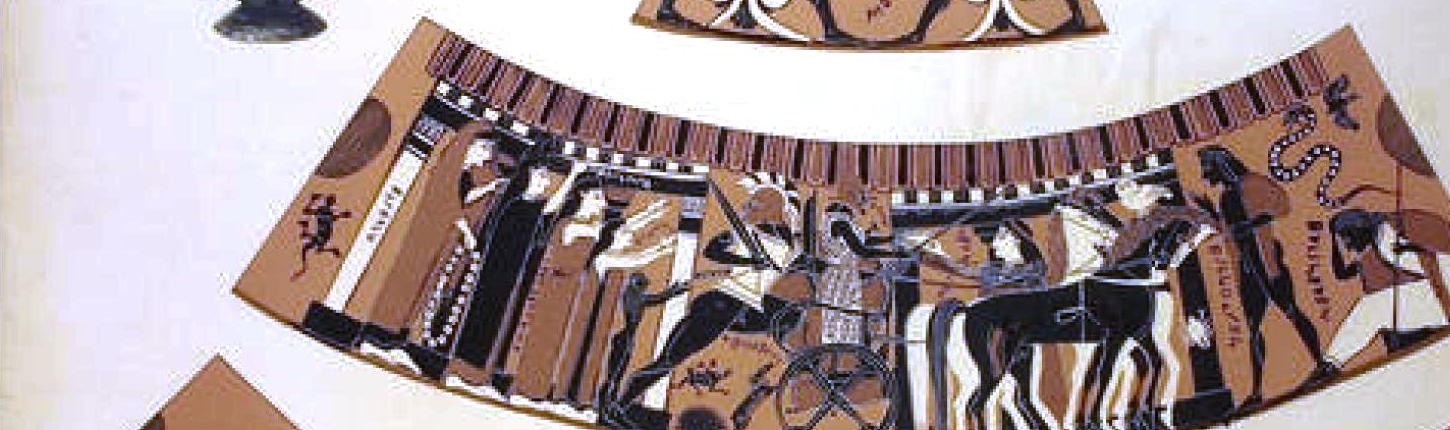
On a Corinthian vessel from around 560 BC, a family sees a warrior off. Beside the chariot stands a woman with a child on her shoulder. The child is Amphilochos, the future seer of Greek legend.
The Seer's Son
The warrior at the chariot is the boy's father, Amphiaraos. He was a seer and knew in advance that he would not come back from this war. To understand why he went anyway, we have to begin with someone else's family quarrel.
Thebes was one of the principal cities of ancient Greece. It was ruled by King Oedipus — the same Oedipus about whom a famous tragedy would later be written. When Oedipus, who had blinded himself, was driven out of the city, power passed to his two sons, Eteocles and Polynices. The brothers agreed to rule in turn: one year one, the next year the other. But when Polynices' turn came, Eteocles would not give up power, and Polynices found himself an exile.
He went to Argos — another powerful city, to the south, on the Peloponnese peninsula. Adrastus, king of Argos, took the fugitive in, gave him his daughter in marriage and promised to win back the Theban throne for his son-in-law. So someone else's quarrel became the business of Argos, and the king's promise was followed by war.
Adrastus gathered an army and set seven leaders over it — one for each of the gates of Thebes: each was to storm his own gate. Among the seven were Adrastus himself, Polynices and Amphiaraos. This campaign passed into legend as the "Seven against Thebes".
Amphiaraos saw the future: of the seven leaders only Adrastus would return. He refused to go and tried to talk the others out of it. But the seer was bound by an old oath. Once he had quarrelled with Adrastus — the brother of his wife Eriphyle — and, on making peace, had promised that if they ever argued again, Eriphyle would decide. Polynices learned of this and brought her a gift that was hard to resist: a golden necklace that, according to legend, had been forged by the smith-god for the first queen of Thebes. Eriphyle decided that her husband would go to war. Amphiaraos submitted to the oath, and as he left he told his sons to avenge him when they were grown. It is this departure that is painted on the vessel: the warrior mounting his chariot, his wife and children beside him.
The prophecy came true. Thebes held out, and of the seven leaders only Adrastus escaped. As the army fled from the walls, the earth, so the legend says, opened and swallowed Amphiaraos together with his chariot.
Ten years later the sons of the fallen leaders — the Epigoni, that is, the "descendants" — marched on Thebes again. Among them were Amphilochos and his brother: in this way they carried out their father's command. This time the city fell.
Later stories also send Amphilochos to the most famous war of the Greeks — to Troy. What became of him afterwards, the legends tell differently. In one version he returned home, could not settle in Argos, went to the west of Greece and founded a new Argos there — Amphilochian Argos. In another he sailed to the opposite edge of the Greek world, to the south of present-day Turkey, and together with another seer founded the city of Mallos. The co-rulers could not share power and killed each other in single combat.
Until 1908 the modern town was called Karvasaras; it then took the name of the historical region. For ancient Argos only a coordinate area is shown: academic gazetteers disagree on its exact location.
The Hero Whom People Asked for Advice
The Greeks believed that great heroes could help the living even after death. Amphilochos was venerated in Mallos — the very city that, according to legend, he had founded. His oracle operated there — a sanctuary where people asked about the future. The answer, it was believed, came in a dream, and it still had to be interpreted.
The circle marks not the city limits but the area of the location: academic gazetteers differ on the coordinates of Mallos by several kilometres.
Amphilochos was also venerated as a healer. His image appeared on the coins of Mallos: an old legend became the emblem of the city.
“Healer hero” — right on the stone
The family of Logos and Symphorousa dedicated a column to Amphilochos. Their son Hermeias is named lifelong priest of “the healer hero Amphilochos”. This is the most direct evidence that in Athens people expected from the hero not only prophecy but also healing.
Ἑρμείας ὁ διὰ βίου ἱερεὺς τοῦ ἥρωος τοῦ ἰατροῦ τοῦ Ἀμφιλόχου“Hermeias, lifelong priest of the healer hero Amphilochos”
The open publication gives no photograph of the column; the key line of the published inscription is shown.
Amphilochos on the city’s money
The obverse of the bronze coin shows the emperor Commodus. The reverse shows the city’s founder Amphilochos: in a laurel wreath, a branch in his hand, a boar standing at his feet. So the hero entered not only the temple cult but also the everyday image of Mallos itself.

On a later issue Amphilochos hands a wreath to the city goddess, and the Latin legend calls Mallos “the colony of Amphilochos”. RPC VI, 7160 ↗
What Remained of the Name
In Greek the name Ἀμφίλοχος is made up of two words: ἀμφί, "around, on both sides", and λόχος, "ambush" or "company of soldiers". What the ancients meant by this combination, nobody knows.
Over time the hero's cult survived only in ancient texts and on coins, but the name lived on. In the 4th century it was borne by a bishop of Iconium. The memory of this holy bishop brought Amphilochius into the Christian calendar — and it was from there that the name came to Rus'.
For researchersSources, caveats and open questions of this chapter
The vessel. A Corinthian krater of around 560 BC, found in the Etruscan necropolis of Cerveteri; now in the State Historical Museum (former Berlin number F 1655). The page shows a detail of the drawing from the publication by Furtwängler and Reichhold. The inscription names the woman with the child as Ainippe. S-GREEK-AMPHIARAOS-KRATER
The campaign against Thebes. The retelling follows the Library of Pseudo-Apollodorus (Book I, 9.13; III, 4.2; 5.9–7.4). Eriphyle is the daughter of Talaus and the sister of Adrastus; the brother of Amphilochos is Alcmaeon. The necklace was forged by Hephaestus, and Cadmus gave it to Harmonia at their wedding; Polynices took it away from Thebes. Pseudo-Apollodorus also names the gate that each of the seven stormed; in other versions the list of leaders differs slightly. The disappearance of Amphiaraos under the earth and his oracle at Oropos are also described by Pausanias. The poems of the Theban cycle survive only in fragments and retellings. S-GREEK-APOLLODORUS S-GREEK-AMPHIARAOS-OROPOS S-GREEK-THEBAN-EPICS
After Troy. The version about Amphilochian Argos on the Ambracian Gulf is given by the historian Thucydides (Book II, 68); the version about Mallos in Cilicia, the co-ruling seer Mopsus and their single combat is given by the geographer Strabo (Book XIV, 5.16). Homer calls Amphilochos and Alcmaeon sons of Amphiaraos but does not say that they took part in the Trojan War. All of this is legend, not history in the modern sense. S-GREEK-THUCYDIDES S-GREEK-STRABO S-GREEK-HOMER
The oracle. That the oracle of Amphilochos at Mallos answered through dreams is reported by Cassius Dio (Book 73, 7; English translation); in the 2nd century the oracle is also mentioned by Pausanias and Lucian. How a consultation was conducted is not known for certain: the sanctuary itself has not been found. S-GREEK-CASSIUS-DIO S-GREEK-PAUSANIAS S-GREEK-LUCIAN-MALLOS S-GREEK-MALLOS-CULT S-GREEK-MALLOS-COINS S-GREEK-CASSIUS-DIO S-GREEK-MALLOS-CULT S-GREEK-MALLOS-COINS
Meaning of the name. Dictionary entries: ἀμφί · λόχος. The meanings of the parts are known; there is no unambiguous ancient interpretation of the name as a whole. S-GREEK-LSJ